



ORGANS OF PARIS © 2026 Vincent Hildebrandt HOME ALL ORGANS
Conservatoire à
Rayonnement Régional
de Paris (CRR)
- Ida Rubinstein
(former Conservatoire National de Région)
14, rue de Madrid, 75008 ParisSalle Rostropovitch
Salle Alain>
Salle 5/6>



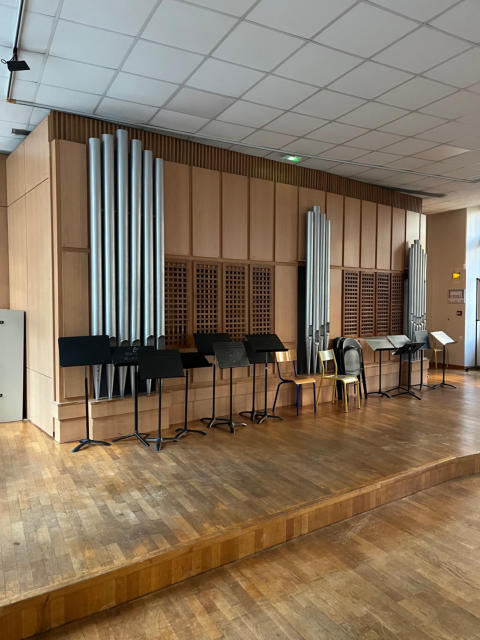
1951 - Jacquot-Lavergne (1)
1981 - Gonzalez (3a)
1999 - Dargassies (3)
2014 - Dargassies (6)
III/32 (26) - electrical traction/électropneumatique
stoplist
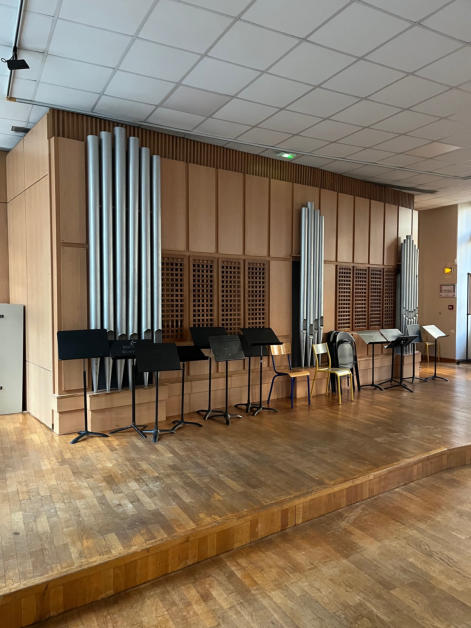
It seems that this organ is no longer in use.
E6
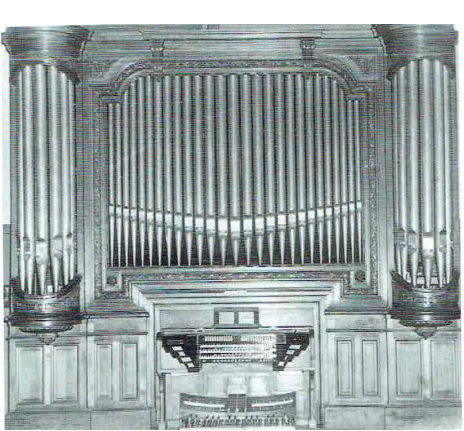
1951
Built on a stoplist drawn up by Marcel Dupré and with part
of the pipework recovered from the organ previously built by
Mutin.
1981
Miscellaneous interventions by Gonzalez, among which new
wind chests.
1994
The organ was dismantled in 1994 by Marc Hédelin in order
to allow the rehabilitation of the former Conservatoire
National Supérieur de Musique into the Conservatoire à
rayonnement régional de Paris
1997
Major reconstruction of the organ by Bernard Dargassies.
The wind chest of the Positif has not been taken back. It was
reassembled into two new expressive chambers; the Zinc-
Montres are fake.
The console, now mobile, has been restored and repackaged
according to the new stoplist of the stops. The transmission
is multiplex + MIDI.


The Jacquot-Lavergne organ replaced a Charles Mutin
instrument (II/22) dating from 1911. It featured the
famous Plein-Jeu known as “du Conservatoire”, developed
by Mutin and Guilmant, based on 1 1/3, with breaks on f²,
c³, f³ and c⁴, the lowest rank having no break on the third c
in order to create a doubling of the 2-foot rank.
The instrument was eventually moved to Lille-Fives by
Gonzalez, where it was completely rebuilt.
Source









Organs of Paris


Conservatoire à
Rayonnement
Régional de Paris
(CRR)
- Ida Rubinstein
(former Conservatoire National de Région)
14, rue de Madrid, 75008 ParisSalle Rostropovitch
Salle Alain>
Salle 5/6>
ORGANS OF PARIS © 2026 Vincent Hildebrandt
1951 - Jacquot-Lavergne (1)
1981 - Gonzalez (3a)
1999 - Dargassies (3)
2014 - Dargassies (6)
III/32 (26) - electrical traction/électropneumatique
stoplist
It seems that this organ is no longer in use.
E6
1951
Built on a stoplist drawn up by Marcel Dupré and with part
of the pipework recovered from the organ previously built
by Mutin.
1981
Miscellaneous interventions by Gonzalez, among which
new wind chests.
1994
The organ was dismantled in 1994 by Marc Hédelin in
order to allow the rehabilitation of the former
Conservatoire National Supérieur de Musique into the
Conservatoire à rayonnement régional de Paris
1997
Major reconstruction of the organ by Bernard Dargassies.
The wind chest of the Positif has not been taken back. It
was reassembled into two new expressive chambers; the
Zinc-Montres are fake.
The console, now mobile, has been restored and
repackaged according to the new stoplist of the stops. The
transmission is multiplex + MIDI.